Across the Mediterranean, the summer table is more than a place to eat. Set beneath olive trees, grapevines and fading evening skies, it becomes an expression of hospitality, memory and the enduring art of gathering. Explore the cultural meaning of Mediterranean dining traditions, from long outdoor meals and communal dishes to heirloom linens, ceramics and recipes made only in summer.
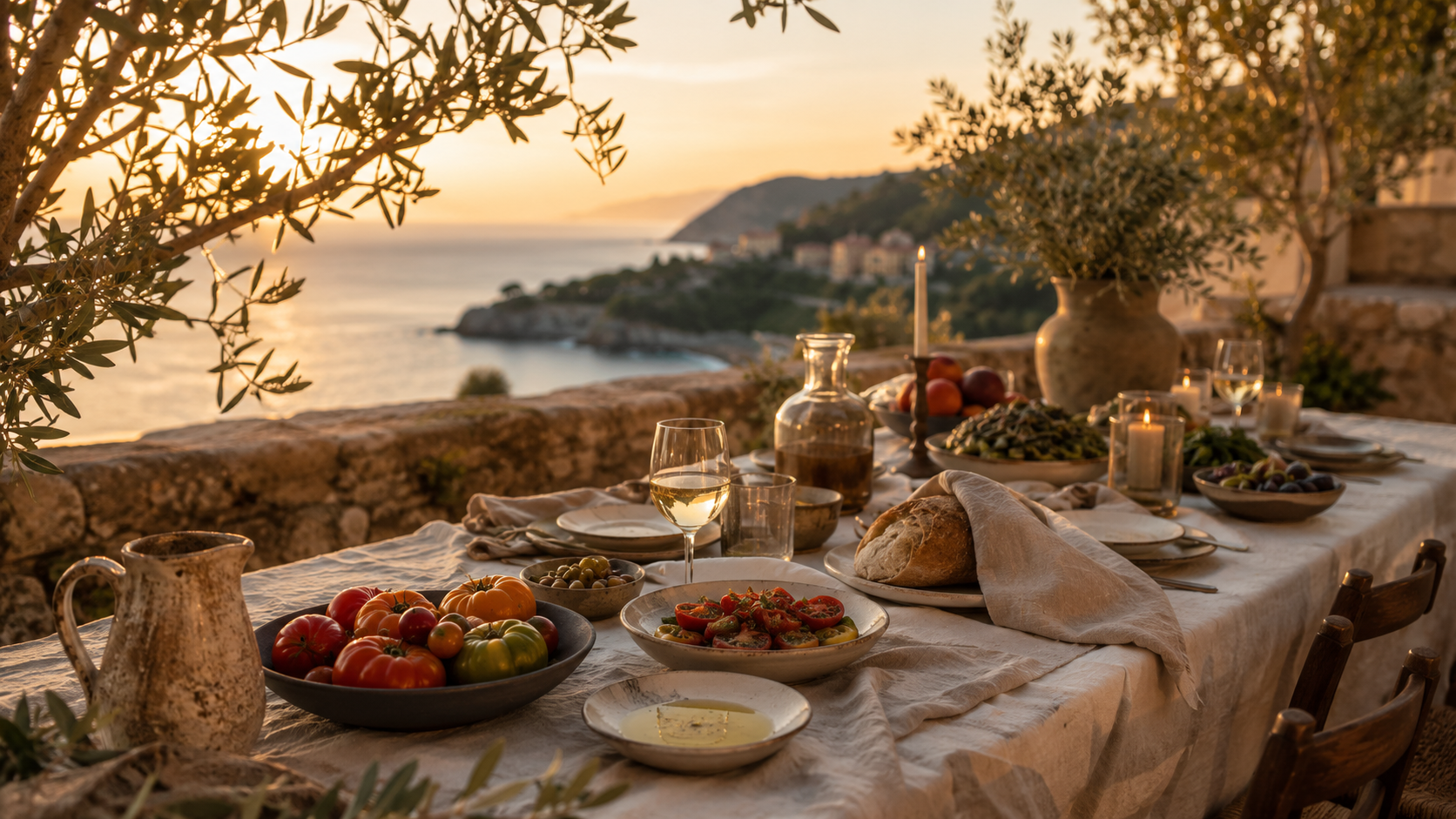
In the late afternoon, while the house is still shuttered against the heat, someone begins to prepare the table. It is pulled from beneath a pergola or carried into a courtyard where the stones have been warming since morning. A linen cloth is opened into the air. Plates appear gradually, carried from a cool kitchen through a doorway fringed with flies and sun. There are tomatoes split open at their ripest point, bread beneath a folded towel and a ceramic jug sweating with cold water. Nothing is quite ready, yet the meal has already begun.
The first guest arrives with peaches. Another brings a bottle of wine. A chair is borrowed from inside, then another. Children cross the terrace with wet hair. Someone tears a basil leaf between their fingers and leans over a simmering pot to decide whether it needs more salt.
By the time everyone sits down, the day has softened. The table seems less assembled than accumulated, shaped by whoever has come and whatever the garden, market or sea has offered.
This is the enduring image of the Mediterranean summer meal: generous but unforced, beautiful without appearing arranged. Yet behind its apparent ease lies an ancient and intricate cultural form. The long table is the descendant of harvest feasts and religious celebrations, of Greek drinking gatherings and Roman civic banquets, of rural kitchens governed by scarcity and season. It carries the history of trade in its glazed ceramics and the private history of families in cloths unfolded only for special occasions. More than a setting, it is a way of organizing life around the belief that food acquires meaning when it is shared.
UNESCO’s recognition of the Mediterranean diet rests precisely on this idea. The word diet descends from the Greek diaita, meaning a way of life, and the tradition encompasses far more than a nutritional pattern. It includes cultivation, fishing, preservation, craftsmanship and the transmission of knowledge from one generation to the next. At its center is the communal meal: a place of hospitality, social exchange and cultural continuity. The summer table makes that philosophy visible.
It also offers a useful lesson for anyone hoping to create such a gathering at home. The essential ingredients are not imported tableware or an impossibly beautiful garden. They are time, seasonality, participation and the willingness to let a meal unfold without controlling every detail.
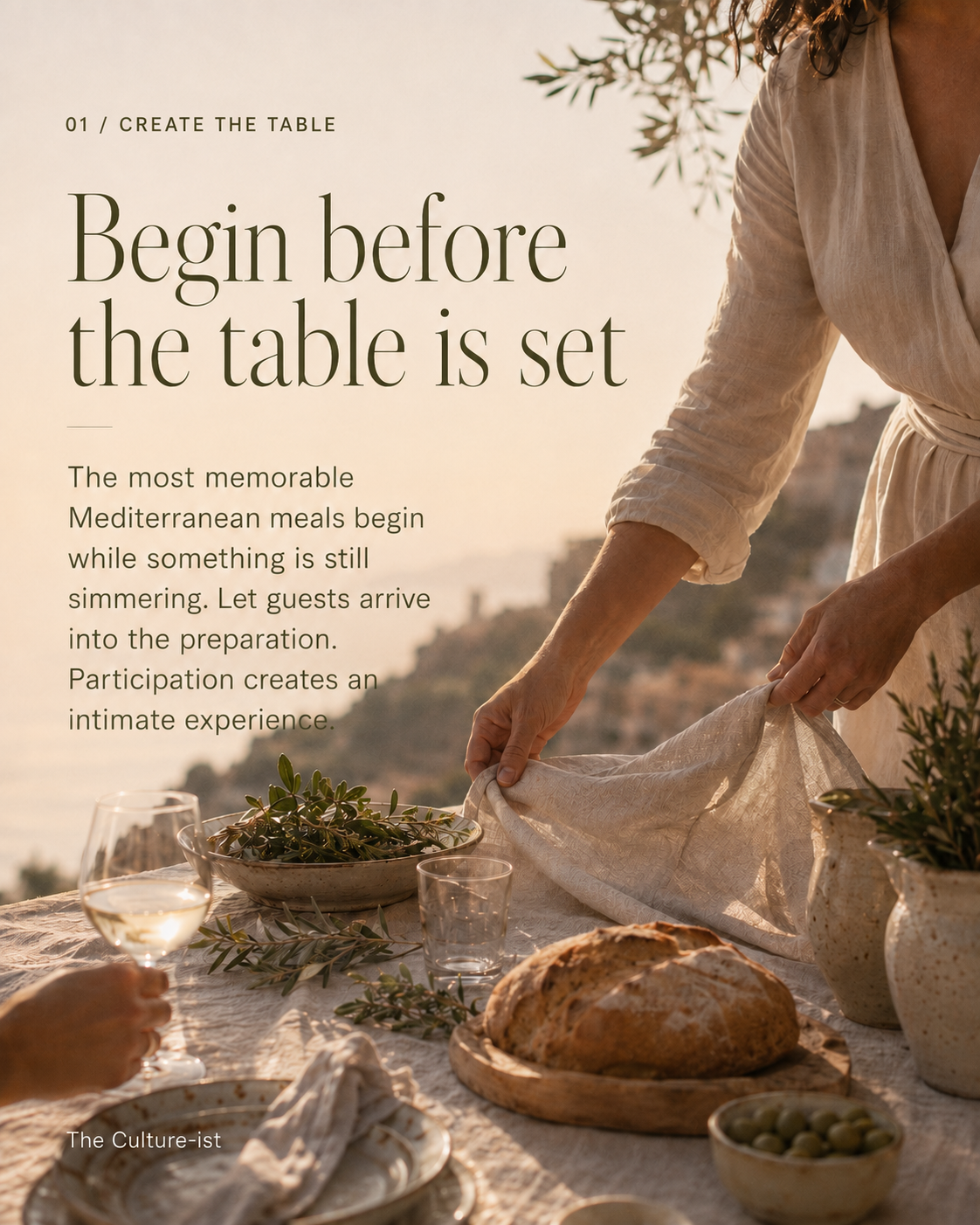
Begin Before the Table Is Set
The most memorable Mediterranean meals rarely begin with a formal invitation to sit down. They start earlier, while something is still simmering and the tablecloth is only half straightened.
Let guests arrive into the preparation rather than after it. Ask someone to slice the bread or carry glasses outside. Let another person tear herbs over a bowl while the first bottle is opened. The small awkwardness of an unfinished scene quickly gives way to intimacy.
This is not merely a hosting technique. For much of history, communal meals were produced communally. Food moved from field, harbor or market into kitchens where knowledge was exchanged through observation. A child learned how to shell beans by sitting beside a grandparent. A neighbor arrived with more fruit than one household could eat. The work of preparing food created its own social space before anyone gathered around the finished meal. That spirit survives whenever guests are allowed to contribute.
A Mediterranean table should not feel as though it has been waiting untouched for an audience. It should feel alive before the first person sits down. Perfection closes a scene. Participation opens it.
Follow the Heat, Not the Clock
The summer table belongs to the hour when the day loosens.
In hot Mediterranean climates, the timing of meals has long been shaped by temperature and labor. The most demanding work traditionally happened in the cooler morning hours, while midday invited retreat behind shutters or thick stone walls. The principal gathering could then begin once the sun had dropped and the body was ready to return to the world.
You do not need a whitewashed villa or a view of the Aegean to follow the same instinct. Delay dinner until the light begins to mellow. Let guests arrive while the sun is still visible, but avoid rushing to serve the meal. Begin with a drink and something simple to eat, then allow the evening to find its own rhythm.
The change in light matters. So does the almost physical relief that arrives when a hot day finally releases its grip. Food tastes different at that hour. Conversation does too.
Artificial brightness can flatten the mood, so resist illuminating every corner. A few jasmine-scented candles, low lamps or strings of warm light allow darkness to gather around the table. The setting should become more intimate as the night deepens, not more exposed. The aim is to make time feel generous.
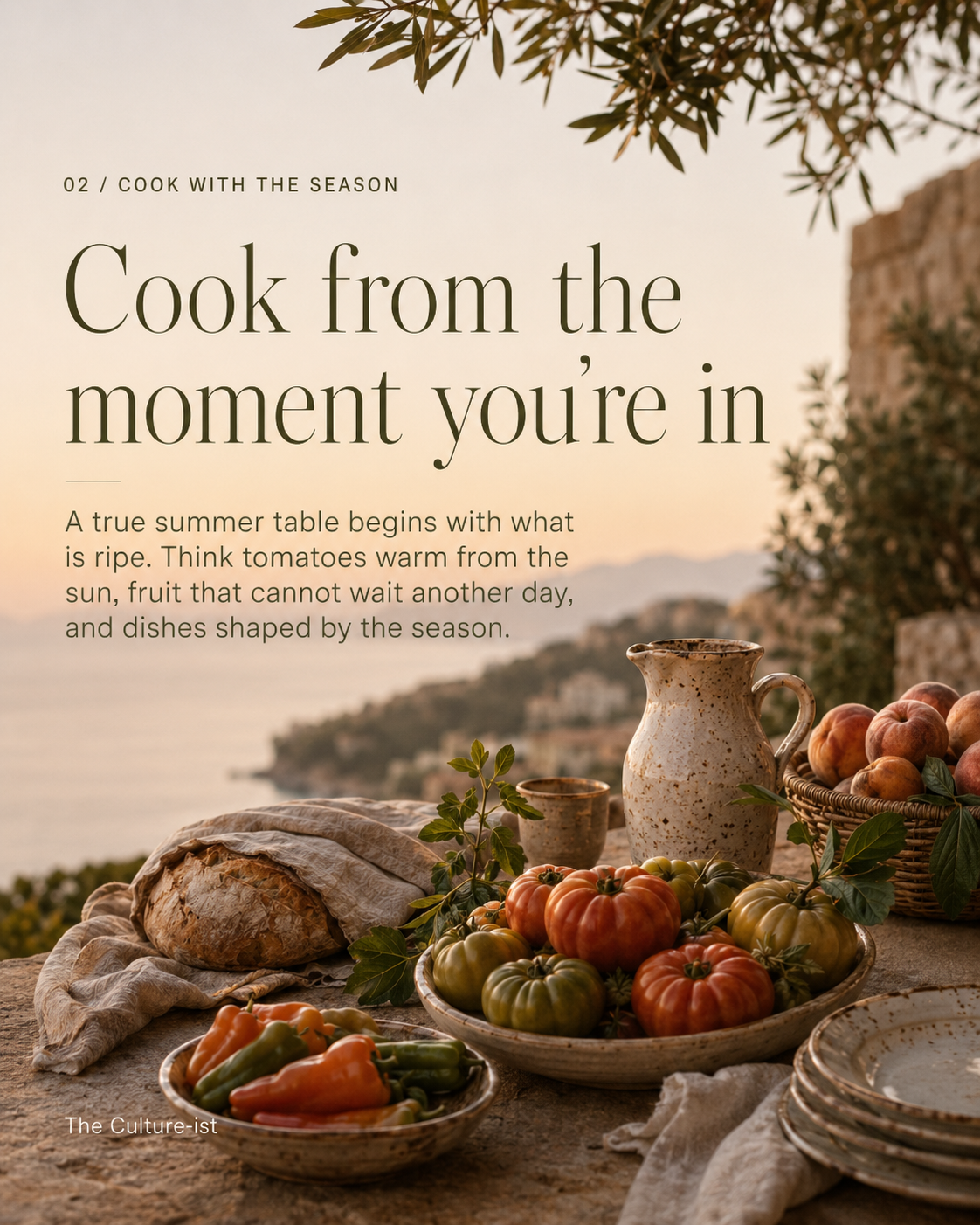
Cook From the Moment You Are In
A true summer table does not begin with a theme. It begins with what is ripe.
Choose the ingredient that seems unable to wait another day and allow the meal to form around it. It may be a tomato so fragrant that little more than salt is required, or a basket of apricots beginning to soften. Perhaps it is corn from a nearby farm, a clutch of zucchini from a neighbor’s garden or fish bought that morning.
Seasonal cooking was once a matter of survival rather than lifestyle. The warm months offered abundance, but also urgency. Fruit bruised. Vegetables softened. Milk soured. What could not be eaten immediately had to be dried, salted, fermented or preserved for the leaner seasons ahead. The summer kitchen therefore learned to honor ripeness at its brief peak. It also learned restraint.
Rather than developing an elaborate menu, prepare one or two dishes that depend completely upon the quality of their ingredients. Let a platter of sliced tomatoes become the center of the meal. Roast peppers until their skins collapse and their sweetness deepens. Serve ripe fruit whole and pass a small knife around the table. The effect should feel less like culinary performance and more like an encounter with a particular week of the year.
A Mediterranean meal in June should not look quite like one in August. The landscape has changed, and the table should admit it.
Place One Generous Dish at the Center
Individual plating creates an invisible border around every diner. A shared dish removes it.
Begin the meal with something substantial enough to draw everyone toward the same center: a wide bowl of pasta, a whole fish, a baked vegetable dish or a platter of food meant to be spooned, torn or passed. The exact recipe matters less than the gesture it requires. A person must reach. Another must offer. Someone notices that the guest at the far end has not yet been served.
This communal choreography has deep roots. Ancient Greek symposium rooms were organized around shared food, drink and conversation, although those gatherings reflected the rigid hierarchies and exclusions of their age. Wine mixed with water was held in a central vessel called a krater before being distributed among the guests. The Romans later used the word convivium—“living together”—for the banquet, revealing how closely the shared meal was connected to social life.
A modern table need not imitate those ancient customs to retain their central insight: the arrangement of a meal influences the relationships around it.
Place too many separate dishes in front of guests and the table can begin to resemble a display. Place one generous preparation in the middle and it becomes an invitation.
The most beautiful moment may be the first one, when the surface is still abundant. The more meaningful moment comes later, when the serving spoon has traveled from hand to hand and the dish bears the evidence of everyone who has eaten from it.
Let the Table Carry a Past
The Mediterranean table has never been defined by flawless coordination. Its depth comes from accumulation.
Use the cloth that has softened with washing rather than the one still creased from its packaging. Bring out a bowl with a small chip along its rim. Place flowers in a pitcher that was never intended to hold them. The objects need not be expensive or genuinely antique. They need only feel as though they belong to a life beyond this single evening.
Inherited linens have particular power because they turn the table into a surface of memory. A cloth embroidered by an aunt or carried from a family home does more than decorate the meal. It places the present gathering upon something another pair of hands once made, folded or saved.
Ceramics carry a broader history of movement. Italian maiolica, the luminous tin-glazed earthenware associated with Renaissance workshops, developed through exchange with Islamic Spain. Its name is commonly linked to Majorca, which served as an important point in the trade between Spain and Italy. By the 16th century, towns such as Deruta, Faenza and Urbino had become major centers of production.
A painted plate may therefore hold several geographies at once: clay from one place, a glazing technique shaped elsewhere and motifs altered through centuries of contact. This is the deeper appeal of a mismatched table. It suggests that beauty has arrived gradually.
Avoid purchasing an entire set merely to create the appearance of heritage. Start with what you already use and love, then borrow what is missing. Let each object bring a slightly different tone. Harmony is more compelling when it has not been manufactured too quickly.
Use Linen Without Protecting It
Spread a real cloth over the table, then allow the evening to happen to it.
The linen may wrinkle beneath elbows. Oil may darken the fibers. A cherry may leave behind the faintest violet stain. None of this ruins the table. It completes it.
The contemporary desire to preserve beautiful things can separate them from the very rituals that once gave them meaning. Historically, household textiles were used, washed, repaired and often passed through generations. Their value was not based on remaining untouched, but on surviving repeated contact with domestic life.
Choose linen or cotton that can be washed without anxiety. Do not iron every crease away. A cloth with movement feels more at home outdoors, especially when its edges lift slightly in the breeze.
Napkins can be placed loosely rather than sculpted into formal shapes. They may be tied with string or simply folded beneath a plate. The point is not rustic styling. It is to restore the material to its purpose.
An heirloom kept permanently in a drawer is an artifact. An heirloom returned to the table becomes part of the family again. Heritage is preserved through care, but it remains alive through use.
Resist the Centerpiece
Nothing on a convivial table should prevent two people from seeing one another.
Instead of building a central arrangement that dominates the scene, gather something small and local. A branch clipped from the garden may be enough. So might a handful of herbs in a low glass or a few flowers leaning naturally in a pitcher.
The arrangement should feel as though it could have been made in the brief interval between checking the oven and opening the door. This restraint returns the focus to the life of the table itself. Food provides color. Wine catches the light. The objects shift as dishes are passed and emptied.
In many rural households, decorative beauty emerged from what was close at hand because there was little reason to separate usefulness from pleasure. A bowl might hold lemons during the day and supper at night. Rosemary cut for cooking might also be laid beside a plate.
The table does not need to announce that it is Mediterranean. Lemon motifs, blue-and-white ceramics and olive branches can easily become shorthand for an entire region whose cultures are far more varied.
Begin with your own surroundings. Use flowers from the yard rather than flowers flown across the world. Fill a bowl with fruit that guests can eat at the end of the meal. Let the table reflect the landscape outside your door. The Mediterranean principle worth borrowing is not a particular look. It is the intimacy between place and table.
Keep the Menu Short and the Evening Long
Hospitality often becomes exhausting when the host confuses generosity with complexity. A Mediterranean-inspired meal does not require a procession of intricately prepared courses. It requires enough food to share and enough calm for people to enjoy it. Choose dishes that can wait without deteriorating and, where possible, improve as they rest.
Prepare most of the meal before guests arrive. A host who remains trapped in the kitchen cannot fully create the atmosphere the gathering is meant to offer.
There is also pleasure in repetition. Place bread and one opening dish on the table while something finishes cooking. Bring out the main preparation when conversation has begun to settle. Later, clear only what is necessary and replace it with fruit. The menu should move with the evening rather than divide it into rigid acts.
This slower rhythm leaves room for appetite to build and recede naturally. It also prevents the host from constantly directing attention toward the next course.
The meal is not a theatrical production. Nothing disastrous happens if a dish arrives ten minutes later than planned. In fact, those unfilled minutes may become the part everyone remembers.
Make Room for the Unexpected Guest
Set one more place than you think you need—or at least remain willing to create it.
The openness of the Mediterranean table is not merely visual. It is ethical. UNESCO’s description of the Mediterranean diet emphasizes hospitality, neighborliness and the sharing of food as central to the tradition. Eating together helps sustain cultural identity because the table remains porous enough for knowledge, stories and relationships to move across it.
At home, this principle can be practiced without staging a grand gathering. Invite the neighbor who happens to stop by. Let a friend bring someone you have never met. Allow children to wander between the meal and their games rather than treating their movement as a disruption.
An additional person should change the shape of the evening without threatening it. This is easier when food is served communally. Portions stretch. Bread fills the gaps. A peach can be cut into four pieces instead of two. The goal is not to create limitless abundance, but to communicate that another person’s presence is more important than the original plan.
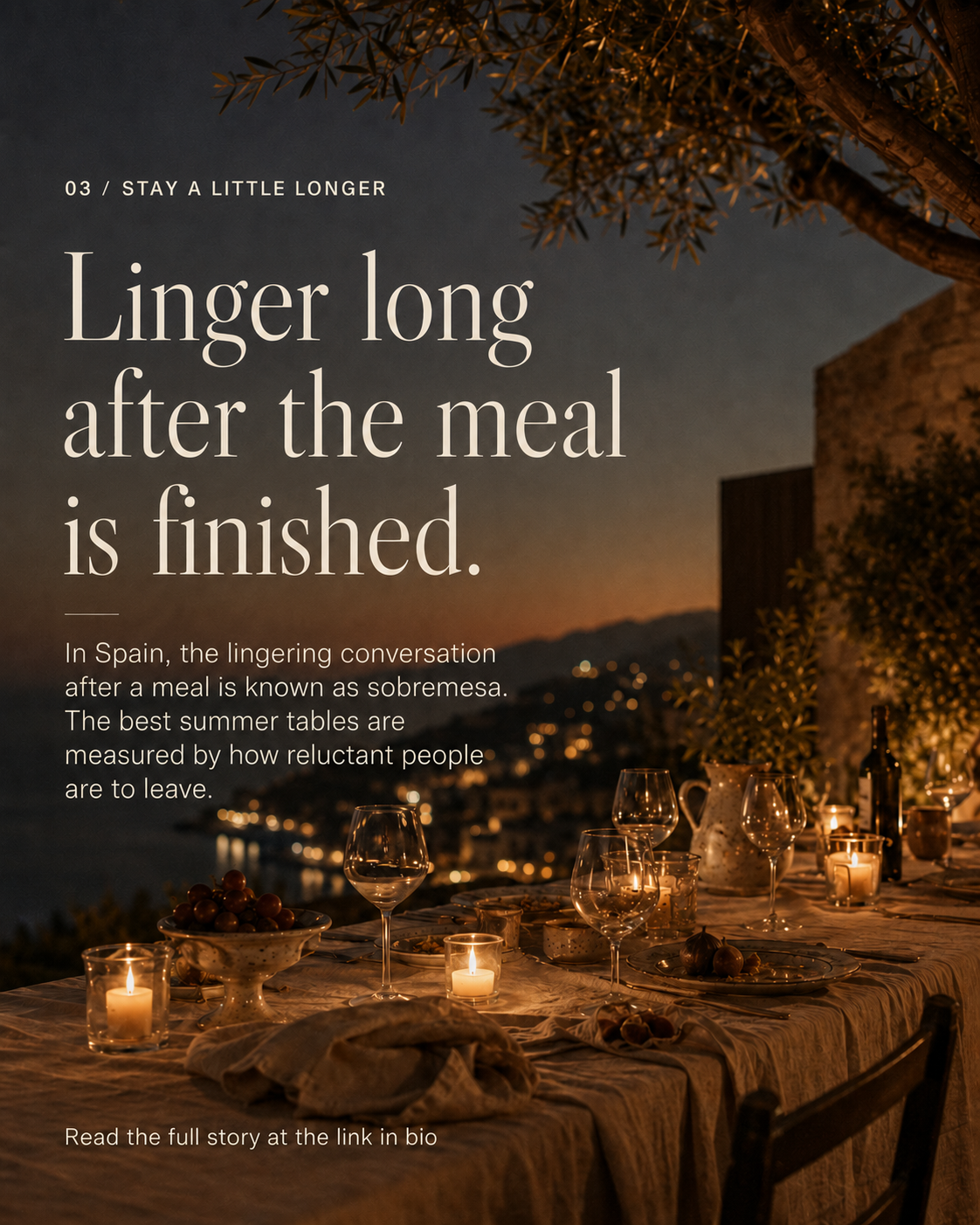
Do Not End the Meal When the Food Is Gone
The most important course may be the one that is never served.
In Spain, the lingering conversation after a meal is known as sobremesa, literally the time spent over or around the table. The custom reflects an understanding that eating creates the conditions for intimacy, but intimacy often arrives only after hunger has been satisfied.
The table becomes lighter as the meal ends. People shift in their chairs. Conversation loses its public polish and moves toward memory, confession or storytelling. No one is occupied by cutting food or deciding what to eat next. This is when the gathering deepens.
Modern entertaining often focuses on the arrival: the reveal of the table, the opening drink, the first impression. Mediterranean dining traditions turn equal attention toward remaining. The success of the evening is not measured by how dramatically it began, but by how reluctant people are to leave. The feeling that, for a few unhurried hours, there was nowhere else anyone needed to be.