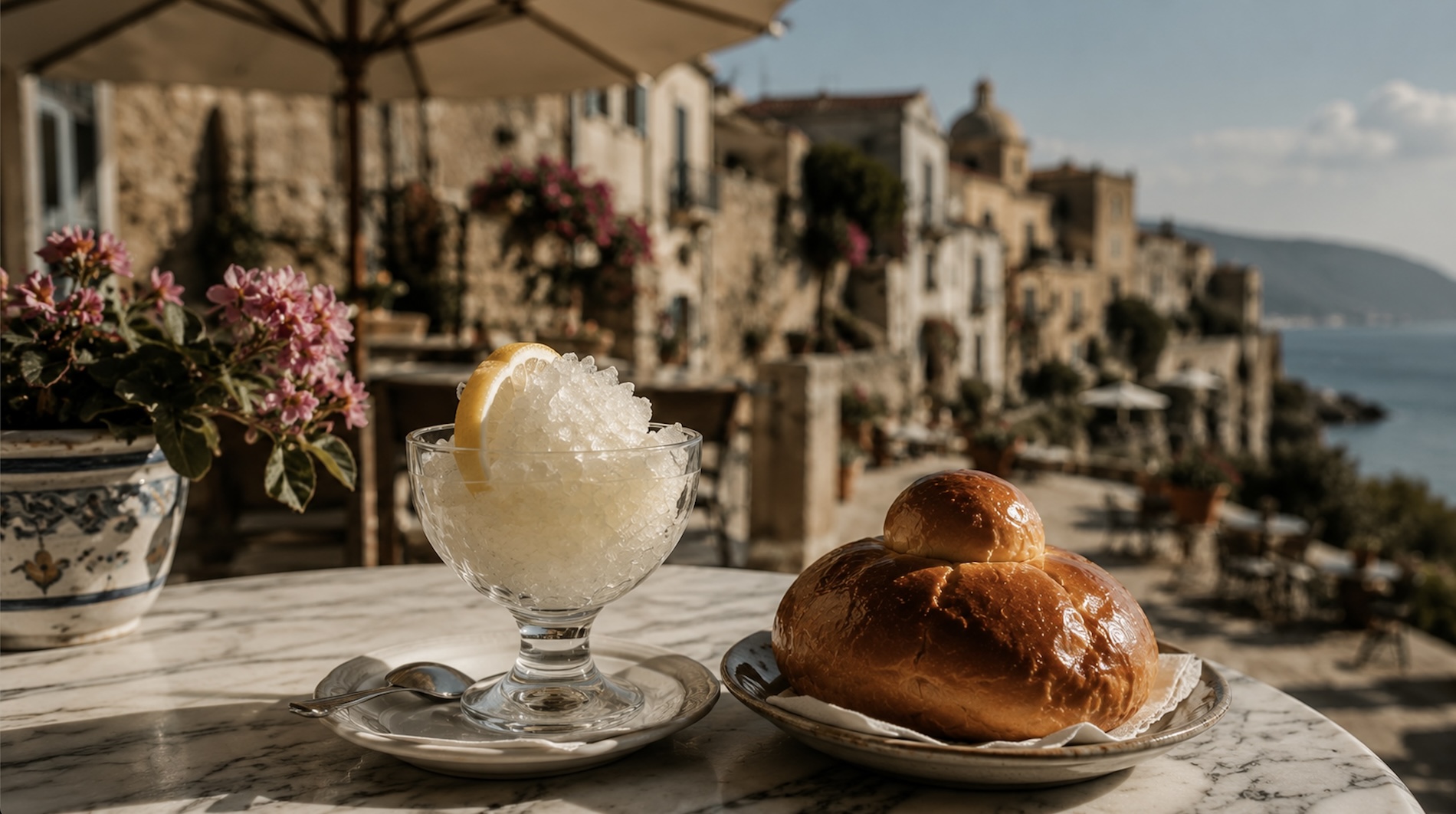
In Sicily, breakfast isn’t always hurried. Sometimes it arrives in a chilled glass, eaten slowly beneath striped umbrellas while church bells echo across a sun-warmed piazza.
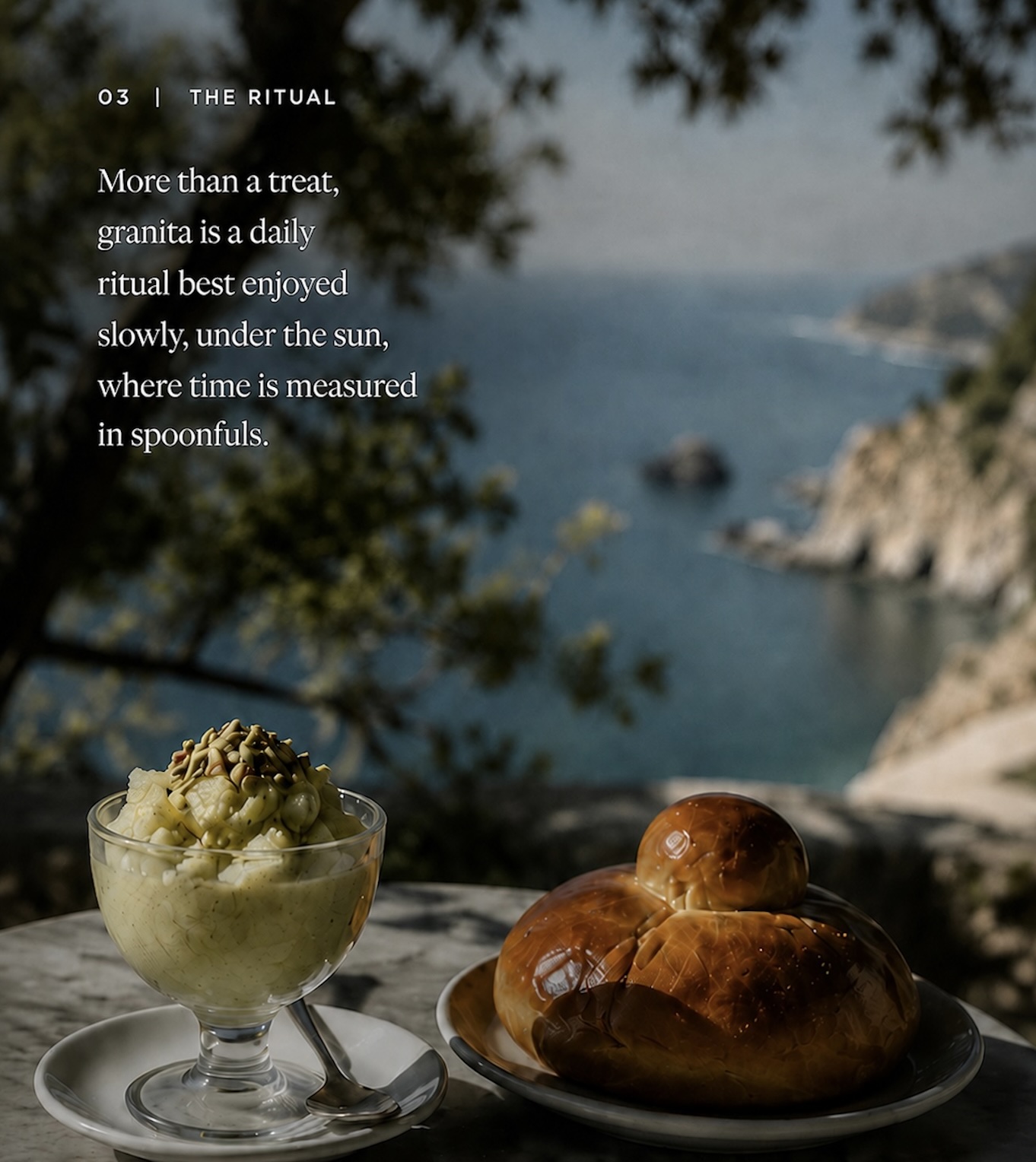
There are few experiences more quintessentially Sicilian than lingering over a glass of granita on a warm morning as the island slowly comes to life. Before the streets fill with Vespas and the afternoon sun turns the stone façades golden, cafés hum with familiar rituals. Locals gather at marble counters, exchanging stories over crystalline mounds of lemon, almond, pistachio, or mulberry granita paired with a freshly baked brioche col tuppo, the island’s iconic sweet bun crowned with its signature topknot.
For visitors, granita may arrive as an unexpected delight. For Sicilians, it is woven into everyday life. It is breakfast after a swim in the Ionian Sea and the afternoon pause beneath the shade of an ancient fig tree. It is the taste of August afternoons and childhood summers, of family traditions carried from one generation to the next. Like so many of Italy’s greatest culinary treasures, Sicilian granita is remarkable not because it is elaborate, but because it elevates a handful of humble ingredients through patience and care.
It is, in every sense, slow food.
A Dessert Born from Snow and the Sea
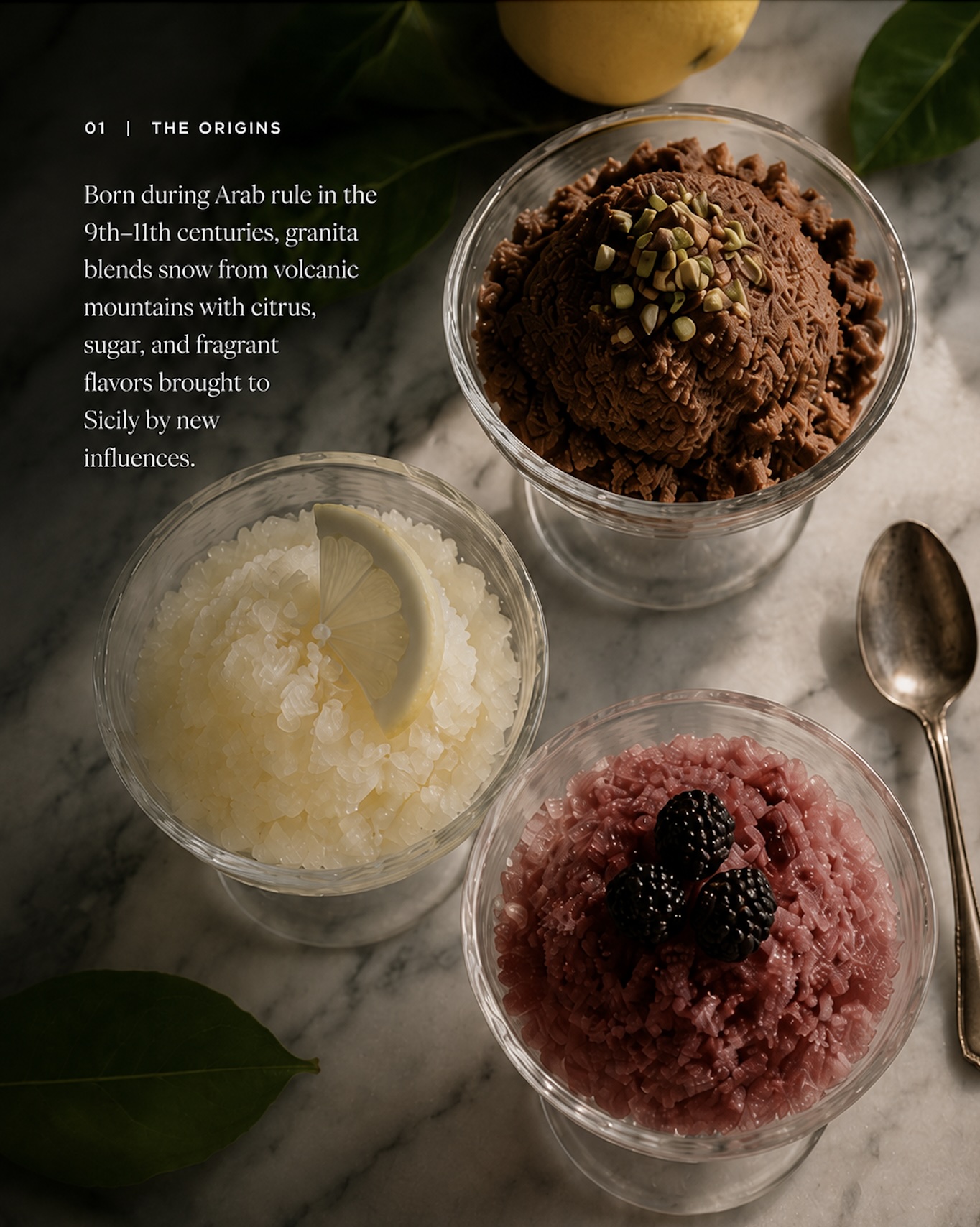
Like so many of Sicily’s most enduring traditions, granita tells a story far richer than its handful of humble ingredients might suggest. It is a story of cultures meeting across the Mediterranean, of volcanic mountains crowned with winter snow, and of artisans who discovered that the simplest pleasures often demand the greatest patience. Its origins stretch back more than a thousand years to the Arab rule of Sicily between the ninth and eleventh centuries, when the island became a crossroads of extraordinary culinary innovation. The Arabs introduced sugarcane, citrus, jasmine, and fragrant syrups, forever reshaping Sicily’s agricultural and gastronomic landscape.
During the winter months, snow was harvested from Mount Etna, the Madonie Mountains, and the Nebrodi range before being packed into stone snow houses known as neviere. Carefully insulated beneath layers of straw and volcanic rock, the snow survived well into the summer. It was shaved and mixed with fruit syrups to create sherbet, from the Arabic word sharbat, meaning “a refreshing drink.”
As the centuries passed, Sicilians refined the technique. Rather than simply pouring syrup over snow, artisans began freezing sweetened fruit mixtures while slowly stirring them, producing the delicate crystalline texture that distinguishes authentic granita today.
One of the pivotal figures in this evolution was the nivarolo, or “the snow keeper.” Long before refrigeration, these skilled workers undertook the physically demanding task of harvesting, transporting, and preserving mountain snow for Sicily’s towns and cities. Though rarely celebrated in cookbooks, the nivaroli were among the island’s earliest frozen dessert artisans. Their knowledge transformed a precious natural resource into one of Sicily’s defining culinary traditions, laying the groundwork for the granita enjoyed today.
With the arrival of mechanical refrigeration in the twentieth century, granita became more widely available, yet many cafés continued to honor the painstaking methods that gave it its unmistakable character. Across Sicily, recipes remain fiercely local. Eastern Sicily, particularly around Catania and Messina, favors an almost silk-like consistency, while western regions often produce a slightly coarser, icier version. Neither is more authentic than the other; they simply tell different stories about place.
The Art of Making Granita
At first glance, granita appears deceptively simple: water, sugar, and fruit. Yet its elegance lies in precision.
The finest granita begins with ingredients at the height of their season: fragrant lemons from the slopes of Mount Etna, almonds harvested in Noto, wild mulberries gathered in early summer, intensely aromatic pistachios from Bronte, or ripe peaches and figs from nearby orchards. The fruit is transformed into a delicate syrup or purée before being combined with water and just enough sugar to preserve both flavor and texture.
What follows is less a recipe than a practice of patience. As the mixture freezes, it is stirred repeatedly, encouraging thousands of tiny ice crystals to form instead of large frozen chunks. The goal is neither sorbet nor shaved ice. Authentic Sicilian granita should melt almost immediately on the tongue, balancing crystalline freshness with remarkable softness.
There is no shortcut for achieving this texture. It requires careful timing, constant observation, and the intuition that comes only from repetition—qualities shared by so many of Sicily’s enduring crafts, from ceramic-making in Caltagirone to hand-weaving in Erice.
The History of Brioche col Tuppo
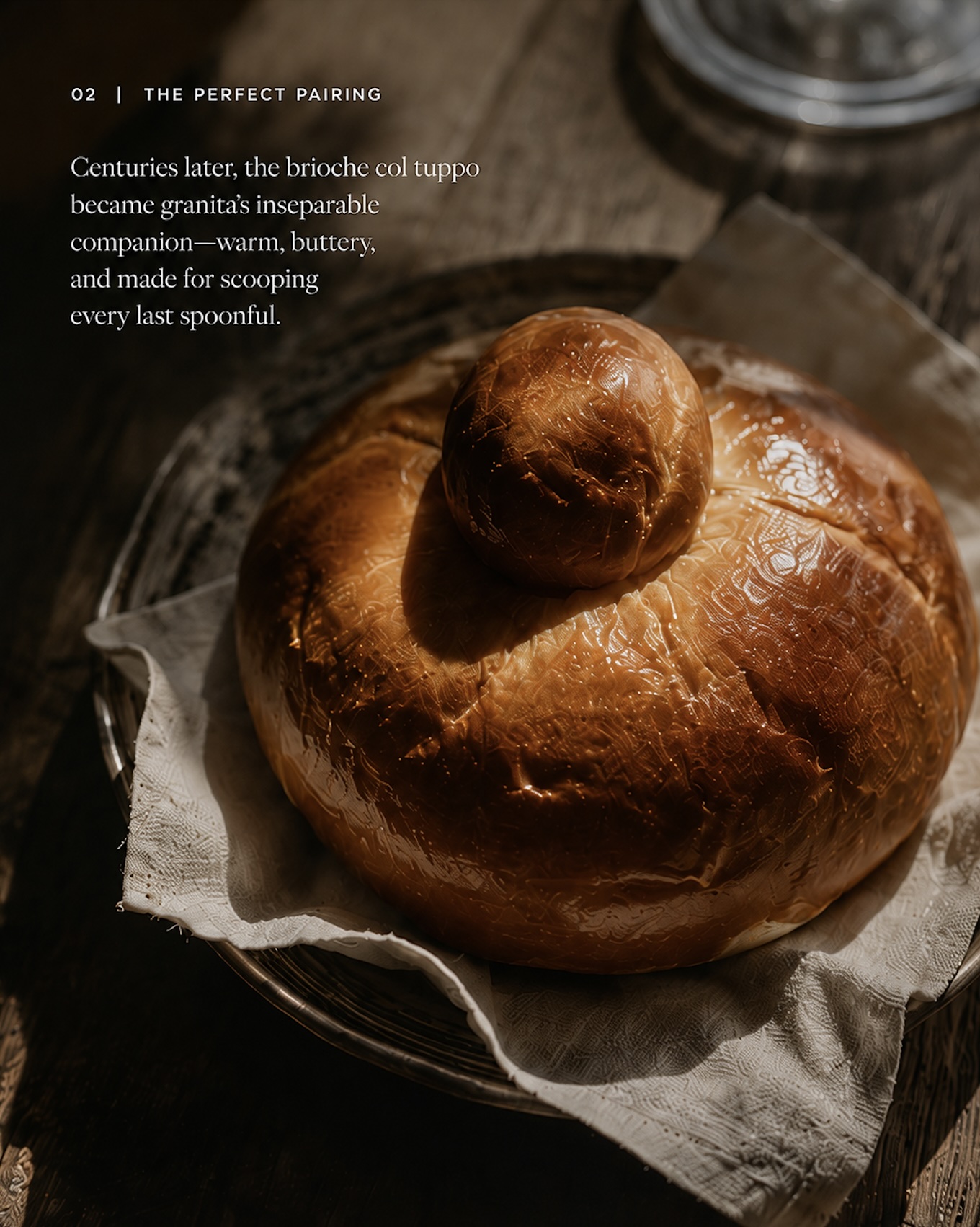
Of course, no discussion of Sicilian granita is complete without its faithful companion: the brioche col tuppo. Today, the pairing feels inseparable, but the brioche arrived centuries after granita itself. Inspired by French baking techniques introduced during the Bourbon period and adapted through Sicily’s rich pastry tradition, the buttery, lightly sweetened brioche evolved into the island’s preferred accompaniment by the nineteenth century. Its distinctive “tuppo,” the small rounded knob of dough perched on top, takes its name from the traditional chignon once worn by Sicilian women. Warm, airy, and enriched with eggs and butter, the brioche offers the perfect counterpoint to granita’s icy delicacy. Locals tear off pieces to scoop up each crystalline spoonful, transforming breakfast into an unhurried ritual that is equal parts texture, temperature, and tradition. What began as a practical pairing has become one of Sicily’s most enduring culinary customs; a reminder that the island’s greatest pleasures are often found in the harmony of simple things.
Where to Find Sicily’s Best Granita
Like wine or olive oil, every Sicilian has a favorite granita. Ask ten locals where to find the island’s best, and you’ll likely receive ten different answers. That debate is part of the tradition. Yet a handful of cafés have earned legendary status for preserving the craft with exceptional care.
Bam Bar — Taormina
Hidden along a leafy lane just beyond Taormina’s busiest streets, Bam Bar has become one of Sicily’s most beloved granita institutions. Its fruit flavors change with the seasons, while the almond granita has achieved near-mythical status. Arrive early to join locals before the tour groups appear.
Try: Almond with coffee granita and freshly baked brioche.
Caffè Sicilia — Noto
Few names are more respected in Sicilian pastry than Corrado Assenza. At Caffè Sicilia, granita is treated as haute cuisine, drawing on exceptional local ingredients and unexpected seasonal combinations without ever abandoning tradition. Every flavor reflects the agricultural richness of southeastern Sicily.
Try: Almond, jasmine, peach, or seasonal citrus.
Bar Alecci — Catania
Just steps from the city’s bustling markets, Bar Alecci serves granita with the creamy consistency for which eastern Sicily is famous. The pistachio and coffee varieties remain enduring local favorites.
Try: Pistachio paired with espresso granita.
Erminio Bar – Siracusa
Beloved by residents of Ortigia, Erminio Bar exemplifies the kind of neighborhood café where daily rituals quietly unfold. The granita is beautifully balanced, allowing Sicily’s exceptional citrus to take center stage.
Try: Lemon or mandarin during citrus season.
Bar Eden — Messina
Messina is often considered the spiritual home of breakfast granita, and Bar Eden remains one of its finest ambassadors. Here, granita is still very much a morning meal rather than a dessert.
Try: Coffee with fresh cream alongside a warm brioche col tuppo.
Bar Condorelli — Belpasso
Located at the foot of Mount Etna, Condorelli has been serving traditional Sicilian sweets for generations. Their almond granita is particularly celebrated for its purity and velvety texture.
Try: Almond made from local Sicilian almonds.
The Sweetness of Doing Less
Granita is not simply something Sicilians eat. It is something they make time for.
There is no urgency in the ritual. Conversations stretch across café tables. The spoon moves slowly between glass and lips. Another espresso is ordered. Children chase pigeons through the piazza while older generations settle into familiar benches beneath jacaranda trees. Nothing extraordinary happens, and yet everything feels deeply complete.
Perhaps this is why granita has endured for centuries.
It reminds us that pleasure need not be extravagant to be memorable. That craftsmanship often reveals itself in restraint rather than complexity. The finest ingredients ask only for patience and respect.
In many ways, granita embodies the Italian philosophy of dolce far niente—the sweetness of doing nothing. Not idleness, but presence. A willingness to let a morning unfold without agenda. To savor what is already before you. To allow a frozen spoonful of lemon, almond, or mulberry to become not simply breakfast, but a small ceremony of place.
And perhaps that is Sicily’s greatest lesson of all: that life’s richest experiences are often the quietest ones, waiting patiently to melt before we rush past them.