There are journeys that feel elective and others that feel inherited. My return to Sicily belonged to the latter. On Salina, the most verdant of the Aeolian Islands, time seems to move according to elemental rules—wind, light, salt, soil. I came carrying family history I could not fully trace and left with something quieter but more enduring: a sense that belonging can be cultivated, designed, and gently offered, like a well-set table at the end of a long day.
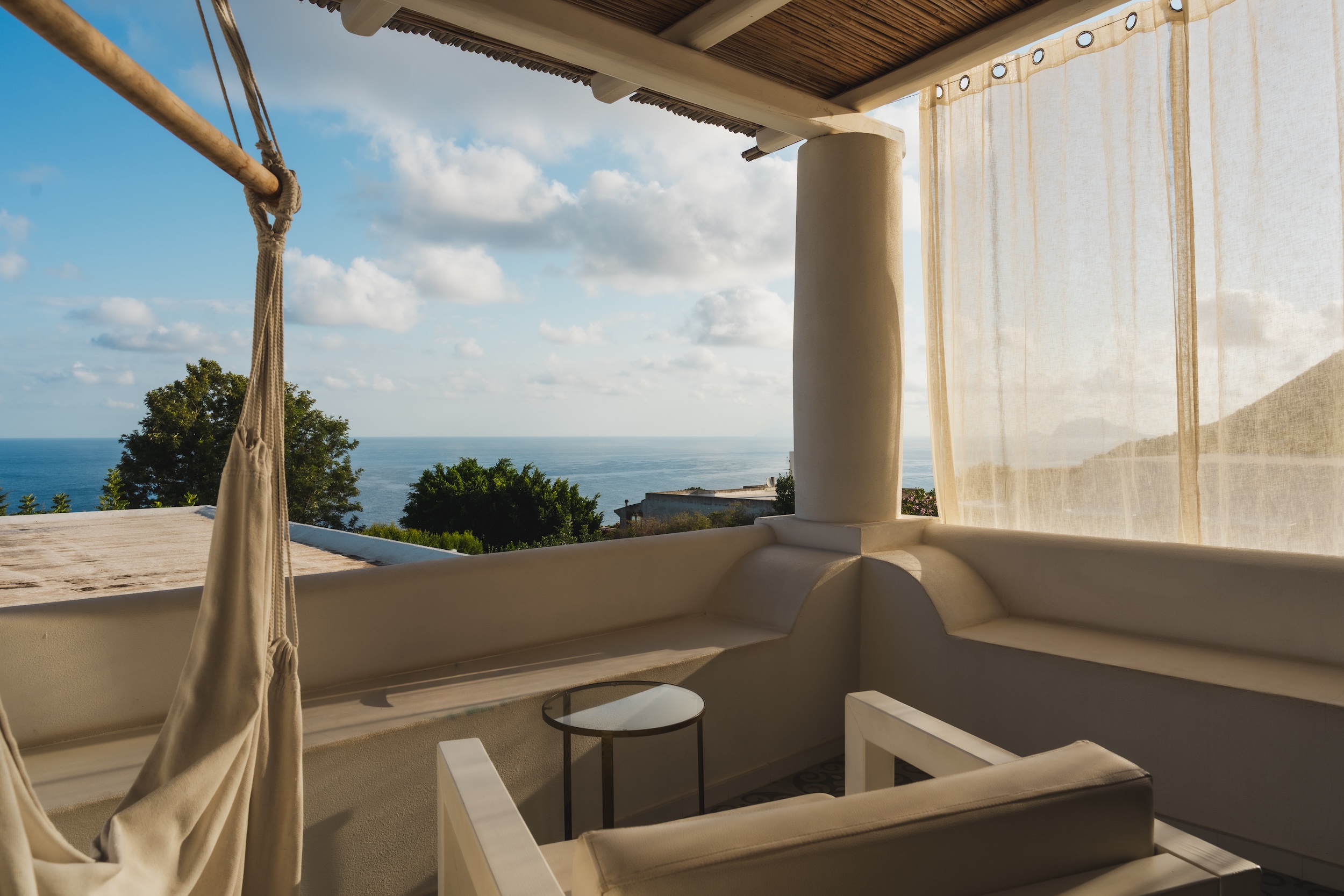
Stepping into Hotel Principe di Salina felt like crossing into a whitewashed sanctuary suspended between sea and sky. Limestone walls caught the cerulean sweep of the Tyrrhenian; at sunset, the horizon dissolved into gradations of pink, amber, and violet. The design was spare but deeply personal — books left as invitations rather than decoration, low-slung seating positioned deliberately toward the view, textiles and artifacts gathered from travels abroad. Nothing felt ornamental. Everything felt placed.
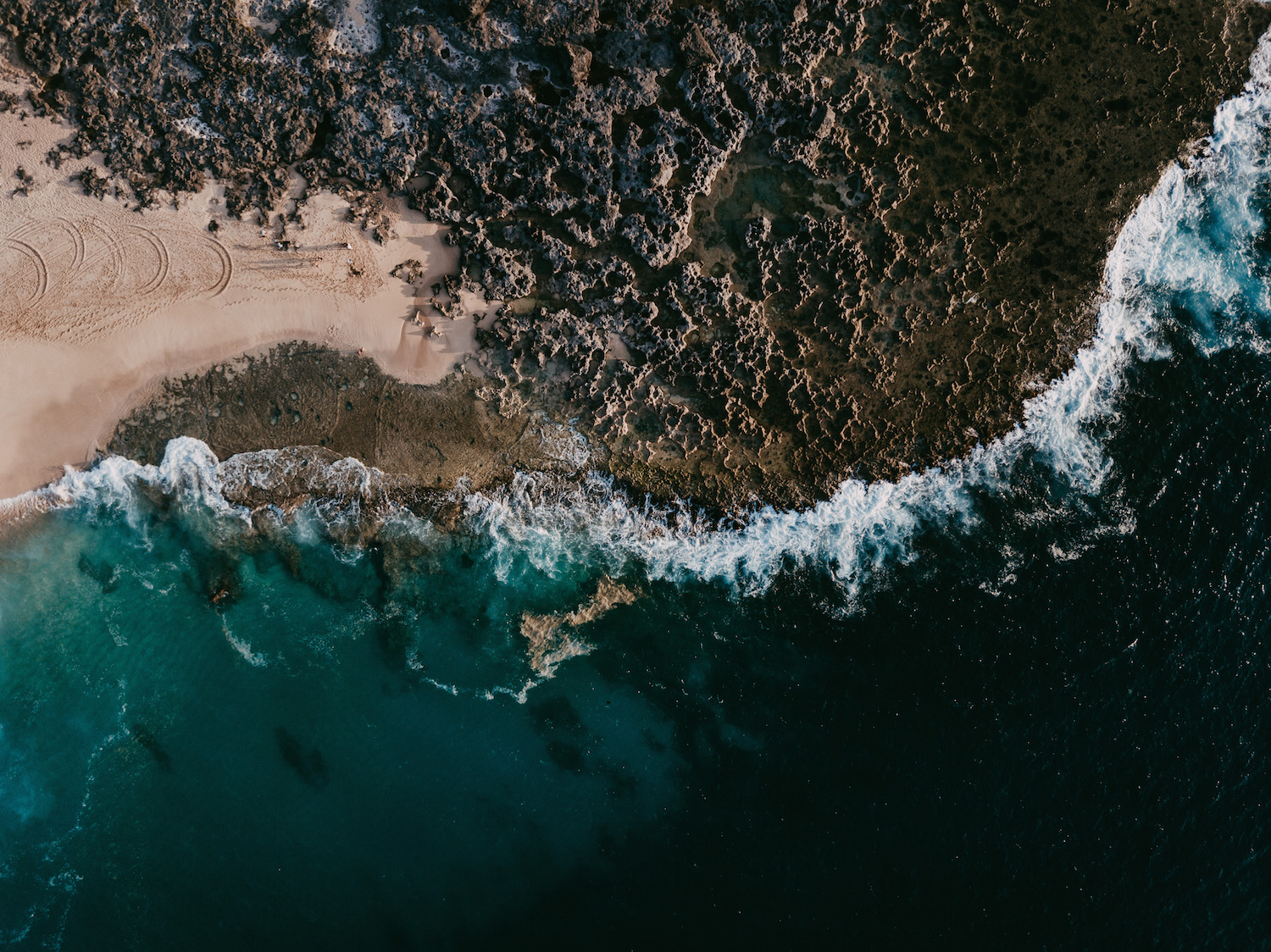
Our room was modest but composed; a terrace opening onto the elemental drama that defines the Aeolian Islands: sea and mountain locked in quiet embrace, volcanic silhouettes rising in the distance. My ancestry traces back to these islands, though the details arrive in my family as rumor more than record. One story tells of my great-great-grandfather, a priest exiled here after a forbidden love affair. Exile is not an unfamiliar chapter in Aeolian history. For centuries, these islands served as remote outposts and places of banishment under various regimes. Later, hardship replaced punishment. In the late 19th century, phylloxera devastated the Malvasia vineyards that sustained the local economy. Volcanic eruptions, heavy taxation, and scarce employment compounded the crisis. By the early 20th century, nearly one-third of the population emigrated, many bound for America. Leaving became as common as staying.
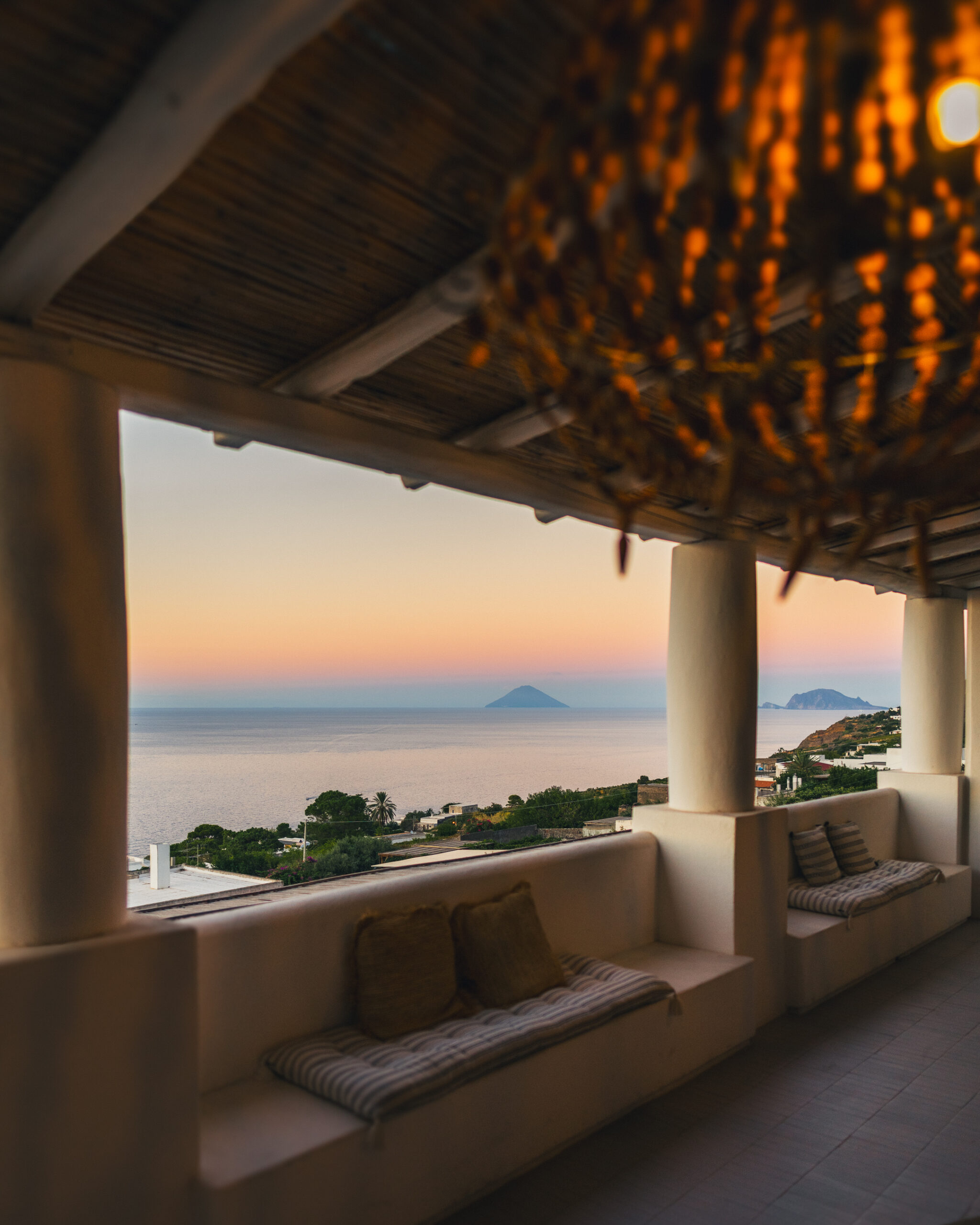
That first evening, my husband and I walked to dinner as the light softened into blue hour. A long communal table overlooked the sea. Other guests gathered, and soon platters of antipasti and blistered, wood-fired pizza arrived, prepared by Filippo, who runs the kitchen. His wife, Anita, co-owner and the quiet force behind the hotel’s spirit, joined us shortly after. She carried herself with easy warmth, her smile immediate and unguarded. She told us she had built the hotel to create what she calls a “home away from home,” a place where strangers might feel less like visitors and more like returning friends. When I shared that we were traveling to Lipari to meet relatives from my maternal grandmother’s side — family I had never met — she did not hesitate. “Welcome home,” she said, as though it were the most natural conclusion.
We fell asleep that night to the steady rhythm of the sea against rock.
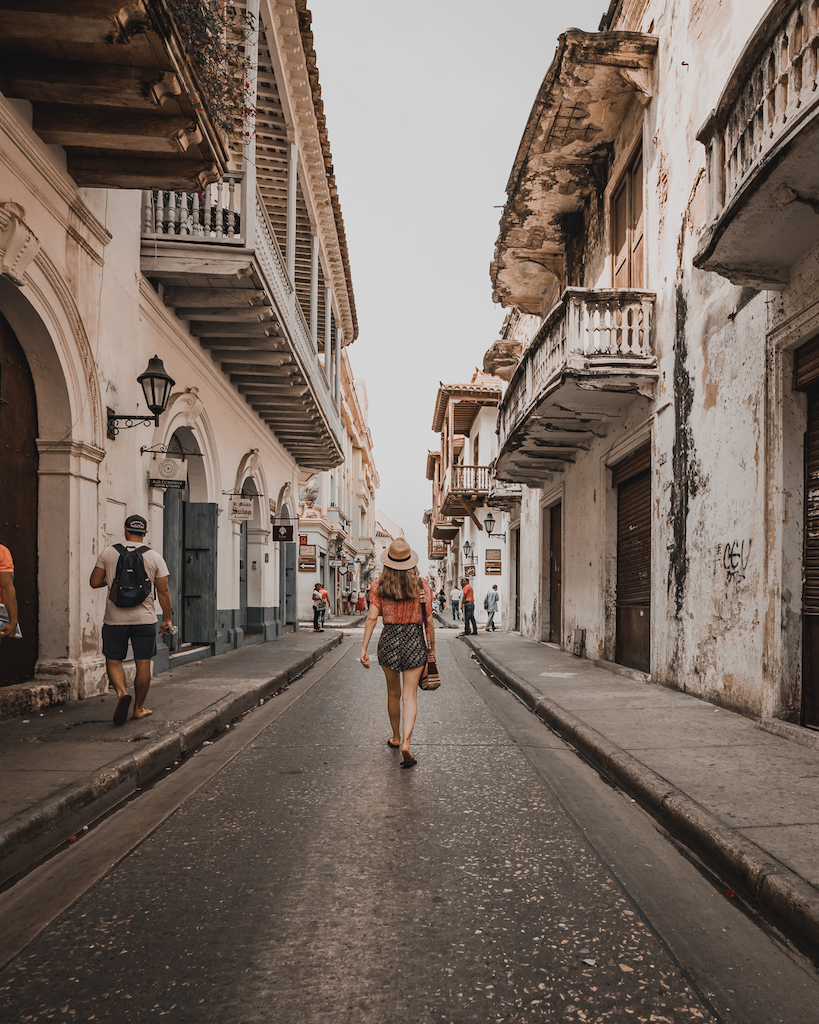
The following morning, we boarded a ferry to Lipari, Salina’s busier sister island. From the water, Lipari rises pale and sun-struck, its harbor lined with fishing boats and pastel facades. In its terrain, arid hillsides, scrubby brush, and dramatic coastline, I recognized something faintly reminiscent of my beloved home in Southern California. But culturally, it felt worlds apart. Streets were built for lingering. Restaurants spilled outward. Gelato shops kissed narrow lanes. Conversations unfolded in doorways and under awnings, punctuated by cigarette smoke and emphatic gestures. The island’s history stretches deep, from Greek settlers to Roman fortifications, from Norman rule to Spanish dominion, each era leaving a visible imprint.
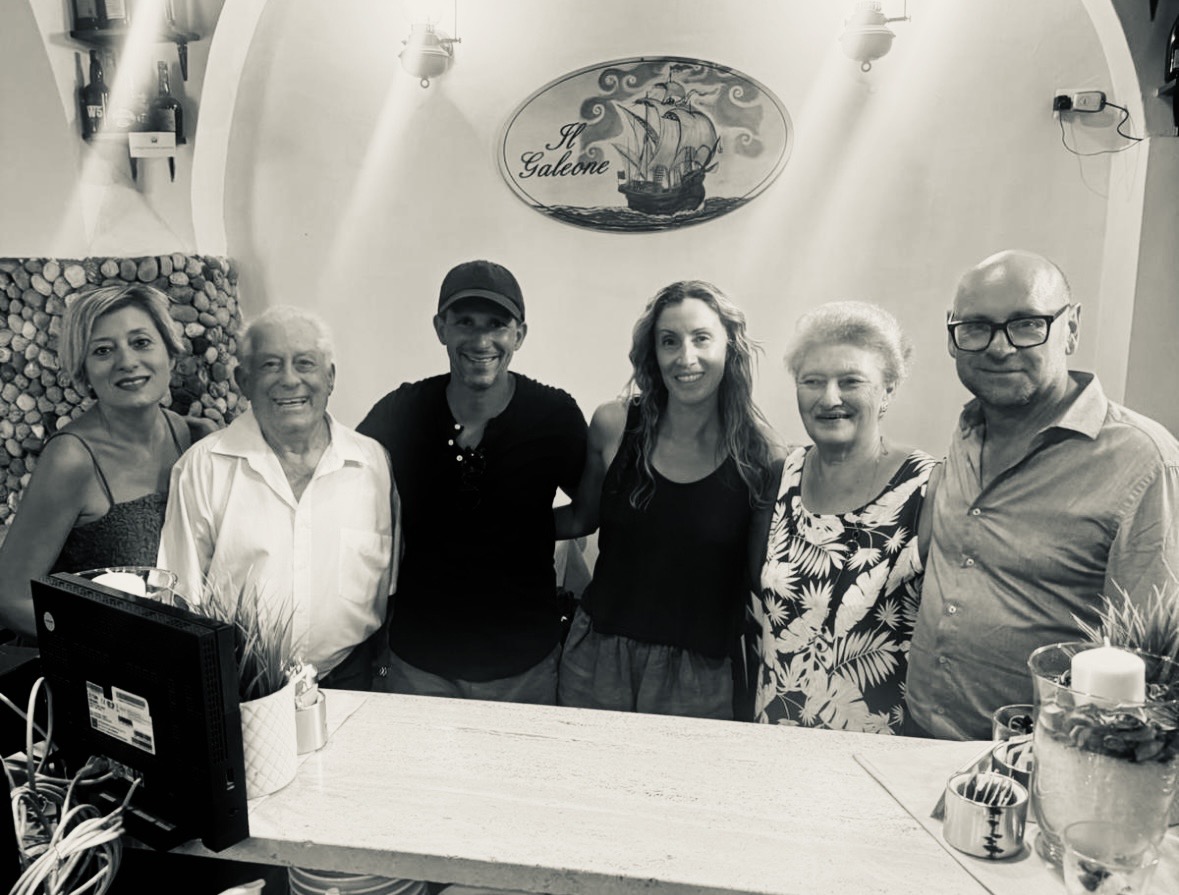
Eventually, we found the restaurant owned by my relatives. I was greeted by my cousins, Domenica, and her parents, Nancy and Pino — Nancy, the daughter of my grandmother’s sister. We sat at a small table as espresso cups appeared, followed by homemade Sicilian cookies dusted with sugar. I opened Google Translate, and together we assembled a halting but heartfelt conversation about my great-grandfather Vincenzo, the first in our family to pass through Ellis Island before settling in Brooklyn, NY. Across languages and generations, fragments of shared history began to align.
Vincenzo, as I came to understand him, was both a rebel and a devoted father. Family lore paints him boarding ships between Lipari and Brooklyn more than a dozen times, sometimes, it is said, as a stowaway. He moved between two worlds with a kind of restless allegiance, bringing his wife, Anna, and their six children across the Atlantic in pursuit of opportunity, then returning again to the island that had shaped him.
But migration rarely unfolds without fracture. Brooklyn did not suit Anna. The density, the cold winters, the distance from language and customs weighed heavily. Eventually, she returned to Lipari with two of their daughters, Domenica and Betty, while my grandmother and her remaining siblings stayed in New York with Vincenzo. He continued crossing the ocean to visit Anna and the girls until he retired permanently to Lipari, where he died. The rest of the family remained in Brooklyn, marrying, raising children, building the lives that would eventually lead to mine.
When Domenica was called back to the rhythm of lunch service, we stood for a photograph — cousins linked by history, if not by fluency. I thanked them, stepped back into the brightness of the harbor, and returned to the ferry that would carry us to Salina.
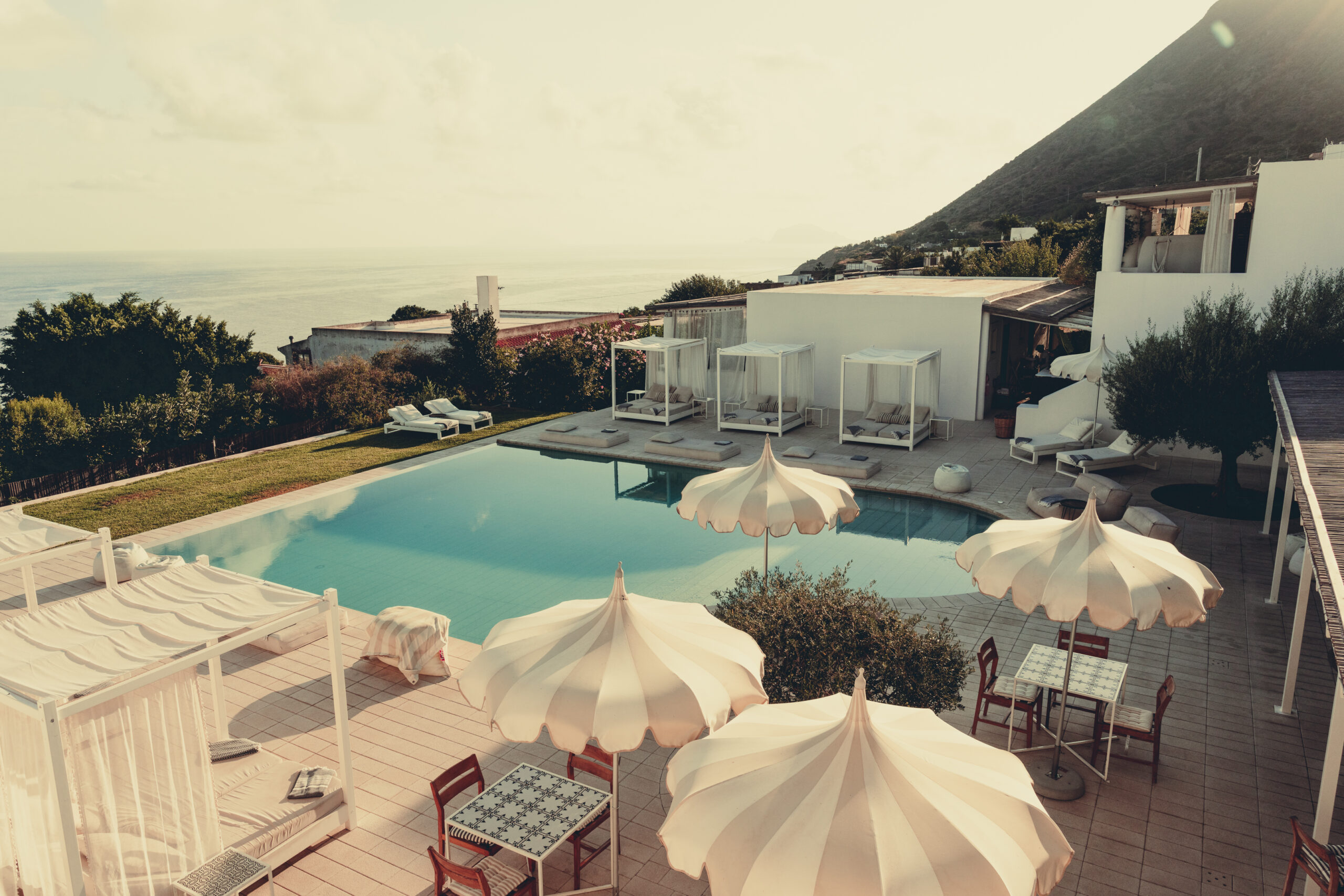
Back at Hotel Principe di Salina, Anthony and I settled beside the hotel’s glassy infinity pool, the sea stretching uninterrupted beyond it. We tried to absorb what had just occurred, the improbable intimacy of meeting family separated by a century of departures. Two British couples we had befriended earlier in the week joined us. Curious, they asked questions. What began as polite conversation evolved into something more searching. Stories were exchanged — about parents, about risk, about reinvention. By the time happy hour arrived, the terrace felt less like a hotel common space and more like a shared living room suspended above the sea.
Anita drifted over just as the light began to fade. In the softening dusk, she told us how the hotel came to be. She had once worked in marketing in New York City; Filippo had been based in Saudi Arabia. For years, they saved, slowly, deliberately, before returning to Salina to begin building. The project unfolded incrementally, supported by her parents, each new space added with care. Nothing was rushed. Nothing was imposed. Their vision was simple but ambitious: to create a place that felt intimate rather than transactional, communal rather than anonymous. They hope, eventually, to expand —perhaps a wellness space and a handful of larger suites—but only in ways that preserve the property’s scale and spirit.
That evening, as we parted for our rooms, the sky had turned the deep indigo particular to islands. My heart felt unusually steady, as if something long unsettled had found its resting place. The sea moved in the dark beyond our terrace. I slipped into sleep not as a visitor passing through, but as someone briefly and unexpectedly at home.
My great-grandfather crossed the Atlantic in search of livelihood and possibility, pulled by the promise of America yet tethered to the volcanic islands that first formed him. His story, like so many from the Aeolians, was defined by departure — by ships leaving harbor, by families divided between necessity and longing. A century later, I arrived by ferry not out of survival, but curiosity. I came looking for origin stories and found instead something more immediate: presence.
On Salina, exile is part of the historical record, and emigration part of the collective memory. To return, even briefly, feels quietly subversive. And yet what lingered most was not the genealogy or even the improbable reunion in Lipari. It was the way space was held — by cousins sharing the intimate history of my family, by strangers leaning closer at a communal table, by Anita’s effortless “welcome home.” In a place where leaving once defined the future, hospitality becomes a kind of restoration.
Hotels often trade in escape, curated distance from daily life. Hotel Principe di Salina offers something subtler and perhaps rarer: proximity. To sea and sky. To shared meals and unguarded conversation. To the realization that home is not always inherited through bloodline or geography, but constructed through care. On an island shaped by departure, Principe stands as a quiet argument for staying, if only long enough to remember what it feels like to belong.